
The 8 C's of Self: Free IFS Handout
Most of us know our inner critic well, or the part of us that worries, or the part that wants to shut everything out. What's easier to forget is that there's also a steady, caring core underneath all of that. In Internal Family Systems, that core is called Self, and it tends to show up as eight qualities that all start with C. This free printable handout describes each one.
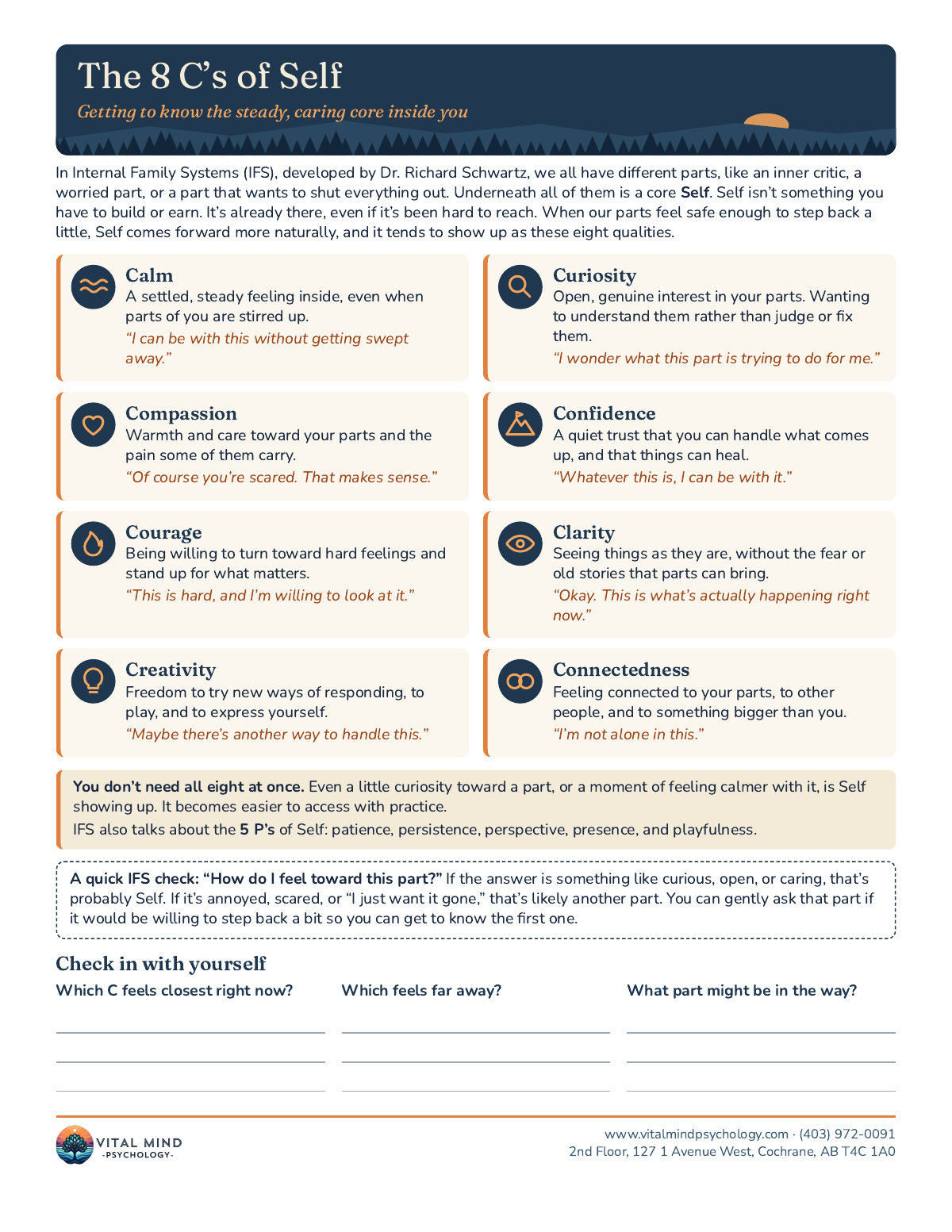
Download the Free Handout (PDF)
What is Self in IFS?
Internal Family Systems (IFS) was developed by Dr. Richard Schwartz. It sees each of us as made up of different parts, each with its own feelings and job. Underneath all of them is Self. Self isn't something you have to build or earn. It's already there, even if it's been hard to reach. When your parts feel safe enough to step back a little, Self comes forward more naturally.
The 8 C's of Self
- Calm: a settled, steady feeling, even when parts of you are stirred up.
- Curiosity: genuine interest in your parts, wanting to understand rather than judge or fix.
- Compassion: warmth and care toward your parts and the pain some of them carry.
- Confidence: a quiet trust that you can handle what comes up, and that things can heal.
- Courage: willingness to turn toward hard feelings and stand up for what matters.
- Clarity: seeing things as they are, without old fears or stories in the way.
- Creativity: freedom to try new ways of responding, to play, and to express yourself.
- Connectedness: feeling connected to your parts, to others, and to something bigger than you.
On the handout, each C comes with a short phrase that captures how it might sound inside, like "I wonder what this part is trying to do for me." The handout also mentions the 5 P's of Self: patience, persistence, perspective, presence, and playfulness.
A quick way to check for Self
When you notice a part, ask yourself, "How do I feel toward this part?" If the answer is something like curious, open, or caring, that's probably Self. If it's annoyed, scared, or "I just want it gone," that's likely another part. You can gently ask that part if it would be willing to step back a bit so you can get to know the first one.
How to use this handout
- Read through the eight qualities slowly.
- Notice which C feels closest right now, and which feels far away.
- Ask what part might be in the way of the ones that feel distant.
- Come back to it over time and notice what changes.
You don't need all eight at once. Even a little curiosity toward a part, or a moment of feeling calmer with it, is Self showing up. It becomes easier to access with practice.
Download the Free Handout (PDF)
Looking for more? Browse our other free handouts, including a parts map worksheet and a feelings wheel.
If you'd like support working through this with someone, the counsellors at Vital Mind Psychology in Cochrane are here to help.