
The Four Horsemen and Their Antidotes: Free Couples Worksheet
Every couple has arguments. What matters more is how those arguments go. Drs. John and Julie Gottman identified four patterns of communication that predict distress in a relationship, and they called them the Four Horsemen. This free printable worksheet describes each one, what it sounds like, and the antidote that helps.
Download the Free Worksheet (PDF)
Where the Four Horsemen come from
Through decades of research with couples, the Gottmans found that certain ways of talking to each other cause more damage than others. The good news is that each horseman has an antidote, a different way of handling the same moment. Every couple slips into these sometimes, so please don't worry if you recognize yourselves. The goal is to notice when a horseman shows up and reach for the antidote instead.
The four horsemen and their antidotes
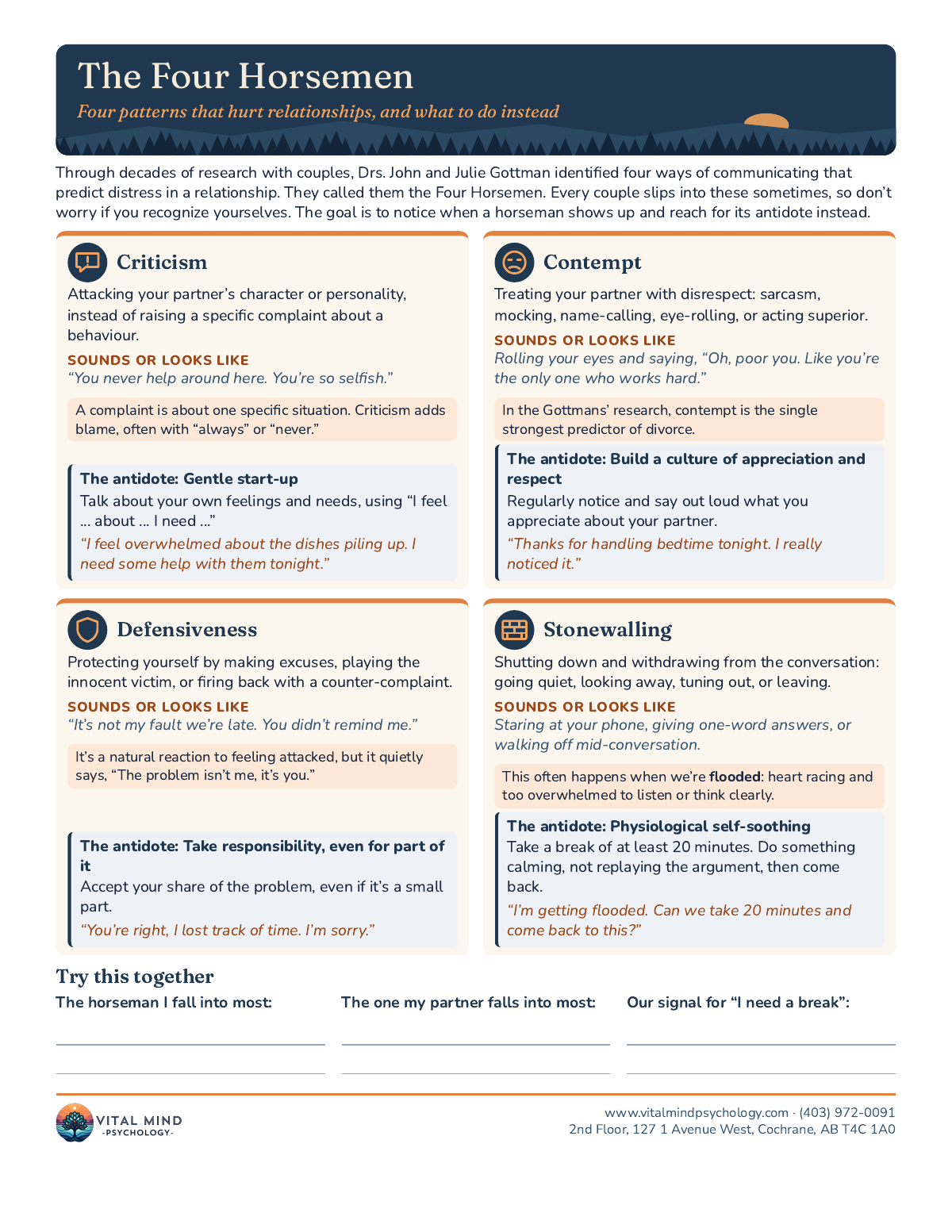
- Criticism: attacking your partner's character instead of raising a specific complaint, often with "always" or "never." Antidote: gentle start-up. Talk about your own feelings and needs: "I feel ... about ... I need ..."
- Contempt: sarcasm, mocking, name-calling, eye-rolling, or acting superior. In the Gottmans' research, this is the strongest predictor of divorce. Antidote: build a culture of appreciation and respect. Regularly notice and say what you appreciate about your partner.
- Defensiveness: making excuses, playing the innocent victim, or firing back with a counter-complaint. Antidote: take responsibility, even for part of it.
- Stonewalling: shutting down, going quiet, tuning out, or leaving. This often happens when we're flooded. Antidote: physiological self-soothing. Take a break of at least 20 minutes, do something calming, then come back.
The worksheet includes a real-life example of each horseman and each antidote, so you can hear the difference.
How to use it as a couple
- Read it together at a calm time, not in the middle of a fight.
- Each of you name the horseman you fall into most. Start with your own, not your partner's.
- Talk about which antidote might help, and practise a few phrases out loud.
- Agree on a signal for "I need a break" so stonewalling can turn into a planned pause.
There's a small "Try this together" section at the bottom with space for all three.
A note on flooding
When your heart is racing and you can't think straight, it's very hard to use any of these skills. That's not a failure. It's your body. Taking a real break, and actually coming back, is one of the most useful things you can do.
Download the Free Worksheet (PDF)
Looking for more? Browse our other free handouts, including a couples repair handout and a feelings wheel.
If you and your partner would like support with this, we offer couples counselling at Vital Mind Psychology in Cochrane, and we'd be glad to help.