
Free CBT Thought Record Worksheet
A friend doesn't text back and within a minute you're sure she's upset with you. Our minds are quick to jump to conclusions, especially when we're stressed or low. This free printable worksheet helps you slow down, spot common thinking traps, and work through a thought record to find a fairer way of seeing things.
Download the Free Worksheet (PDF)
What is a thought record?
A thought record is one of the core tools of cognitive behavioural therapy (CBT), which grew out of the work of psychiatrist Dr. Aaron Beck. The idea is simple: how we interpret a situation shapes how we feel about it. When we notice our automatic thoughts and check whether they're the whole story, the feelings attached to them often soften.
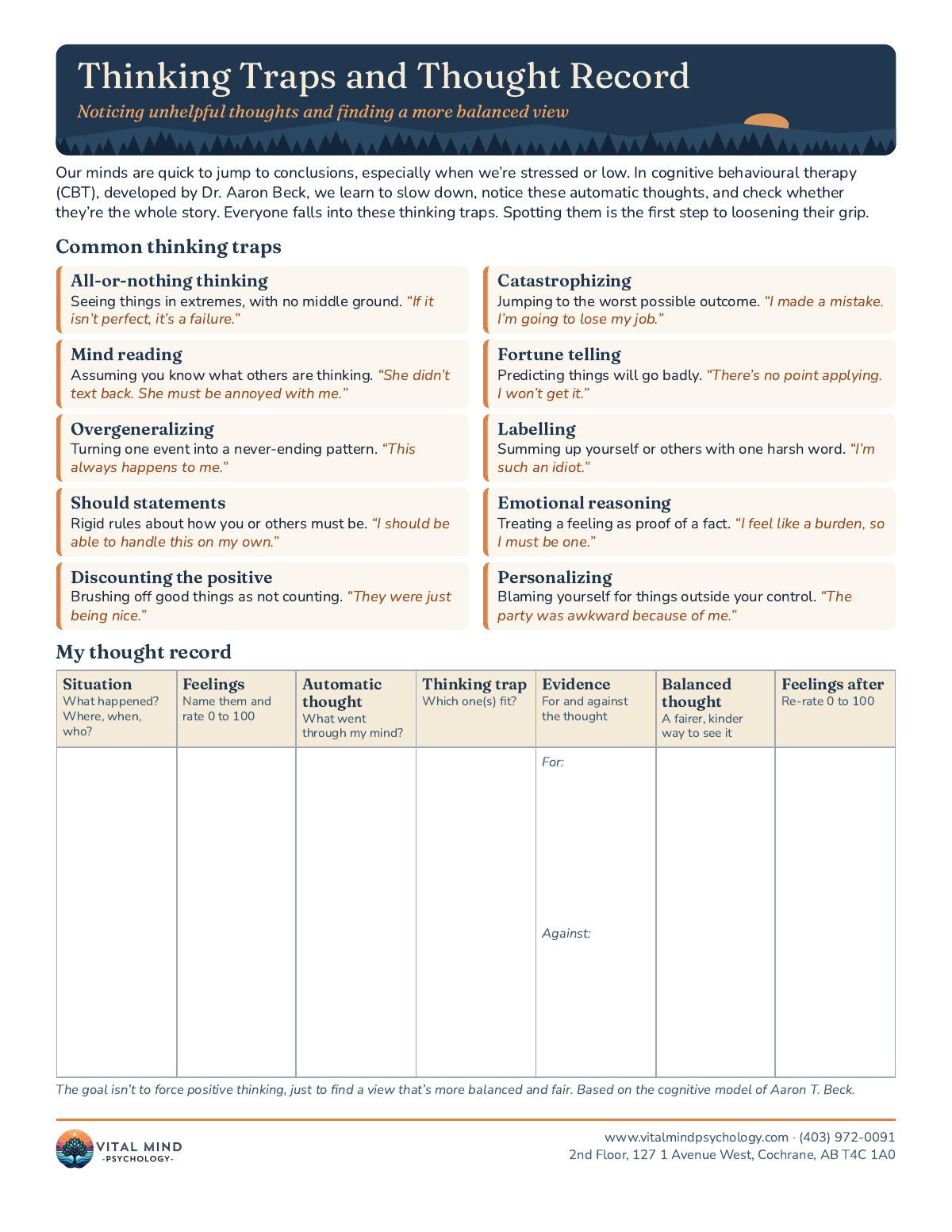
The 10 thinking traps on the worksheet
- All-or-nothing thinking: "If it isn't perfect, it's a failure."
- Catastrophizing: jumping to the worst possible outcome.
- Mind reading: assuming you know what others are thinking.
- Fortune telling: predicting things will go badly.
- Overgeneralizing: turning one event into a never-ending pattern.
- Labelling: summing up yourself or others with one harsh word.
- Should statements: rigid rules about how you or others must be.
- Emotional reasoning: treating a feeling as proof of a fact.
- Discounting the positive: brushing off good things as not counting.
- Personalizing: blaming yourself for things outside your control.
Each one comes with an everyday example on the sheet. Everyone falls into these. Spotting them is the first step to loosening their grip.
How to fill in the thought record
- Situation: what happened? Where, when, and who was there?
- Feelings: name them and rate how strong each is, from 0 to 100.
- Automatic thought: what went through your mind?
- Thinking trap: which trap or traps fit?
- Evidence: what supports the thought, and what doesn't?
- Balanced thought: a fairer, kinder way to see it.
- Feelings after: re-rate your feelings from 0 to 100.
Tips for getting the most out of it
- Fill it in when you notice a strong shift in mood, or later the same day.
- Look for evidence a good friend would point out.
- Don't expect your feelings to drop to zero. A small shift is a real win.
The goal isn't to force positive thinking. It's to find a view that's more balanced and fair to you.
Download the Free Worksheet (PDF)
Looking for more? Browse our other free handouts, including a feelings wheel and a values worksheet.
If you'd like support working through this with someone, the counsellors at Vital Mind Psychology in Cochrane are here to help.