
Free Window of Tolerance Worksheet
Some days you can handle almost anything. Other days a small thing sends you spinning, or you go flat and can’t seem to care. That’s not a character flaw. It’s your nervous system doing its job, and the window of tolerance is one of the most helpful ways we know to make sense of it. This free printable worksheet walks you through it.
Download the Free Worksheet (PDF)
What is the window of tolerance?
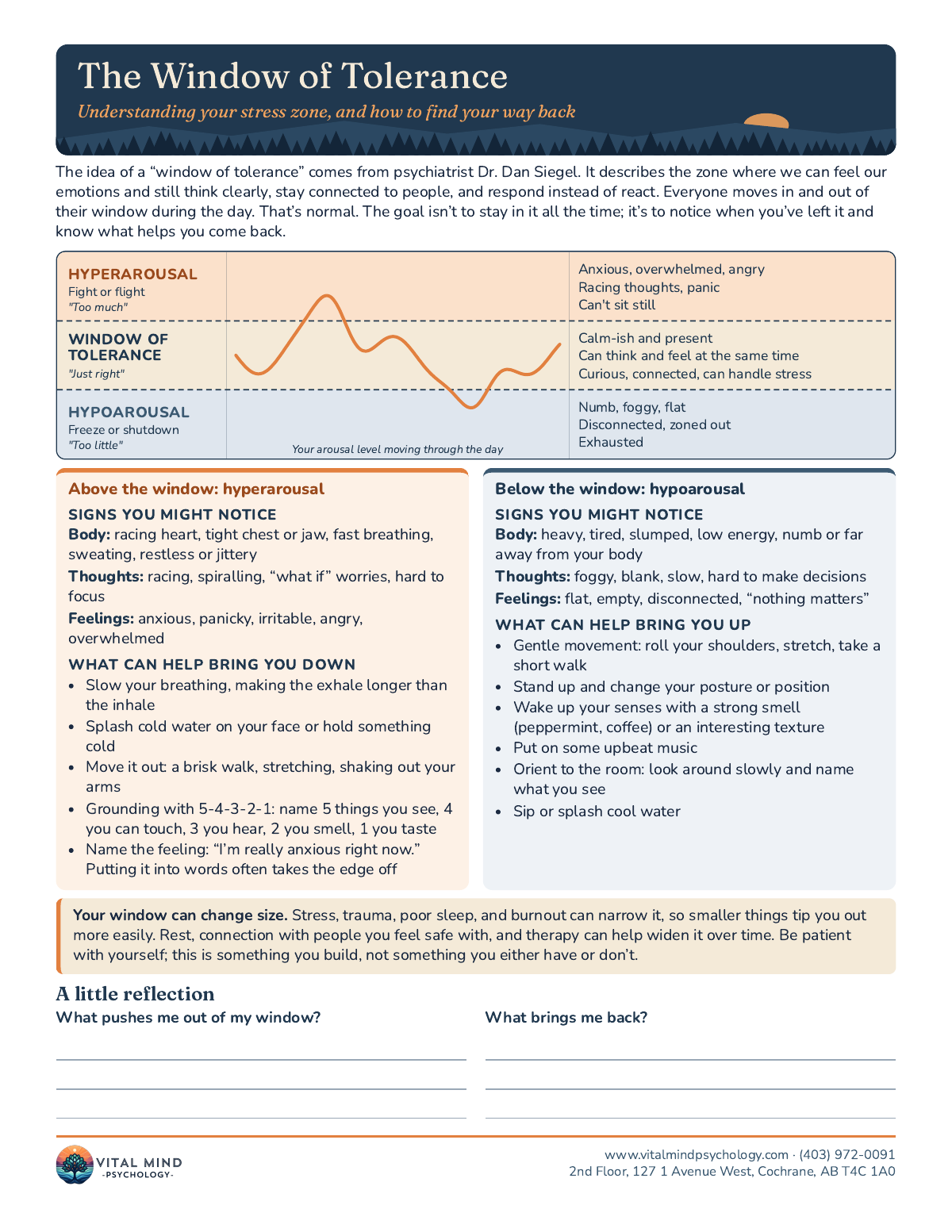
The idea comes from psychiatrist Dan Siegel. Your window of tolerance is the zone where you can feel things, even hard things, and still think clearly, stay connected to people, and respond instead of react. Inside the window, emotions come and go like waves you can ride.
When stress, old memories, or exhaustion push you past the edges of that window, your body shifts into survival mode. You either go up into hyperarousal or down into hypoarousal. Everyone's window is a different size, and it changes from day to day. Sleep, hunger, stress, and past experiences all play a part.
Signs you're above your window (hyperarousal)
- Racing thoughts or feeling on edge
- Anxiety, panic, or anger that comes on fast
- Tight chest, fast heartbeat, shallow breathing
- Trouble sleeping or sitting still
- Feeling overwhelmed or ready to snap
Signs you're below your window (hypoarousal)
- Feeling numb, flat, or shut down
- Low energy, heaviness, wanting to hide
- Feeling foggy, spacey, or far away
- Trouble speaking up or making decisions
- Going through the motions on autopilot
How to use this worksheet
- Notice where you are. A few times a day, check in. Am I inside my window, above it, or below it?
- Learn your signs. Look over the body, thought, and feeling signs for each zone and notice which ones sound like you.
- Reflect. At the bottom of the sheet, jot down what tends to push you out of your window and what brings you back.
- Try what helps. Use the ideas on the sheet to come back down or back up, and keep the ones that work for you.
It works well on your own, and it's also a great thing to bring into a counselling session.
Ways to widen your window
- If you're above: slow your breathing with long exhales, splash cold water on your face, go for a walk, or press your feet into the floor.
- If you're below: gentle movement, upbeat music, a strong smell or taste, or naming five things you can see.
- Over the long run: steady sleep, regular meals, time outside, and safe relationships all help your window grow. So does practising being with small amounts of discomfort, gently.
Be patient with yourself. Widening your window is slow work, and every time you notice where you are, you're already doing it.
Download the Free Worksheet (PDF)
Looking for more? Browse our other free handouts, including grounding skills and a feelings wheel.
If you'd like support working through this with someone, the counsellors at Vital Mind Psychology in Cochrane are here to help.