
Free Psychedelic Integration Journal
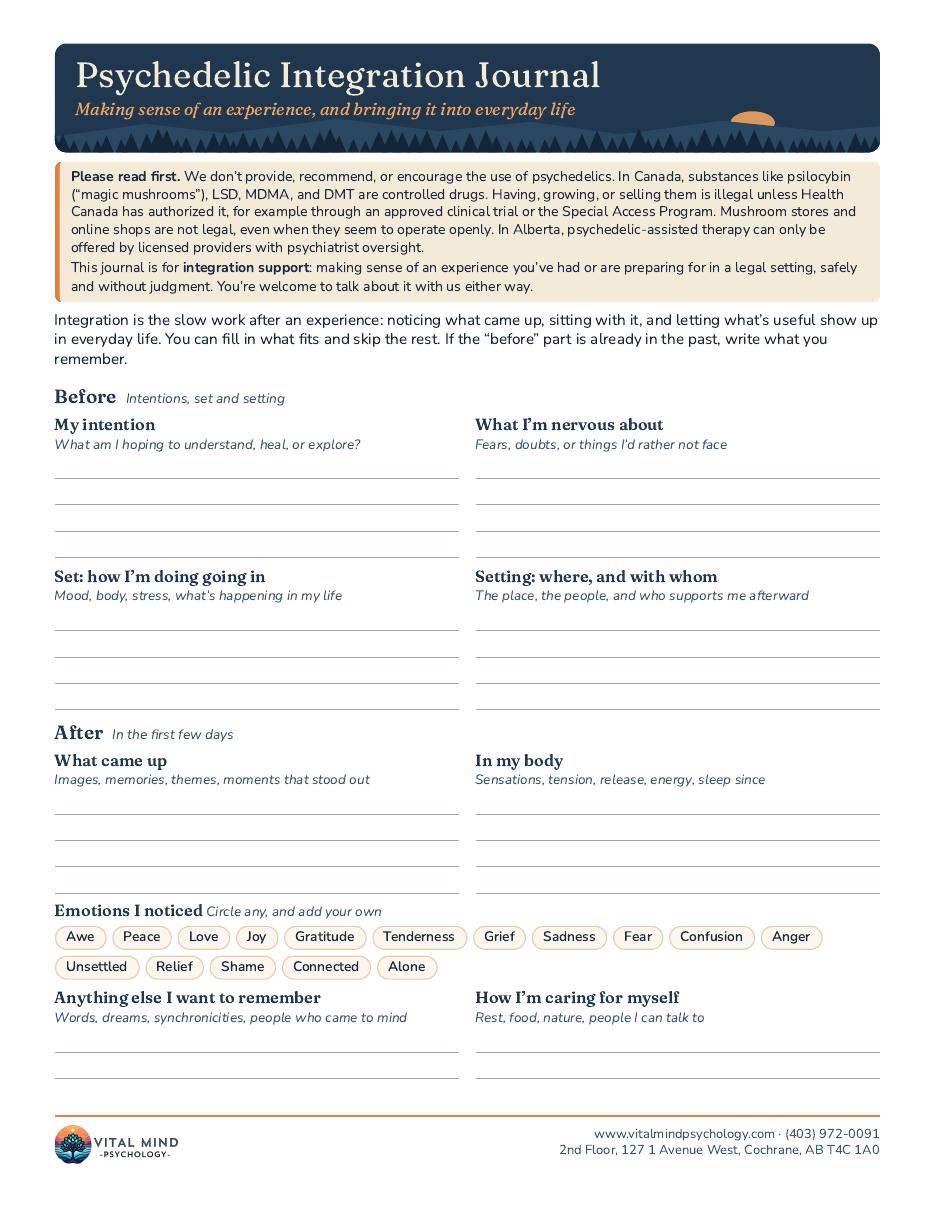
Some people come to therapy wanting to make sense of a psychedelic experience they've already had, or one they're preparing for in a legal setting like an approved clinical trial. This free printable journal gives you a gentle structure for that, before, right after, and over the weeks that follow. It's here for integration and safety, not to encourage use.
Download the Free Journal (PDF)
Please read first
We don't provide, recommend, or encourage the use of psychedelics. In Canada, substances like psilocybin ("magic mushrooms"), LSD, MDMA, and DMT are controlled drugs, and having, growing, or selling them is illegal unless Health Canada has authorized it, for example through an approved clinical trial or the Special Access Program. Mushroom stores and online shops are not legal, even when they seem to operate openly.
Psychedelics also carry real risks, especially when mixed with other substances or some medications, like lithium or certain antidepressants, and for people with a personal or family history of psychosis or bipolar disorder. If you have questions about your health or medications, please talk with your doctor or pharmacist.
Whatever has happened, you're welcome to talk about it with us without judgment.
What is integration?
Integration is the slow work after an experience: noticing what came up, sitting with it, and letting what's useful find its way into everyday life. Powerful experiences can leave people with insight, but also with confusion, grief, or questions that don't settle right away. Writing things down helps you hold onto what mattered and look at it again with fresh eyes.
In a 2022 review in Frontiers in Psychology, Geoff Bathje and colleagues looked at how the word is used and described integration as a process of revisiting and actively working with an experience, so that what came out of it can be carried into lasting changes in daily life. They also noted it can happen in many ways, through the mind, the body, relationships, and the world around you.
What's in the journal
The journal is two pages, in three parts.
- Before. Your intention, what you're nervous about, how you're doing going in ("set"), and where and with whom ("setting"), including who supports you afterward. If this part is already in the past, you can write what you remember.
- After, in the first few days. What came up, what you noticed in your body, a list of emotions to circle (from awe and peace to grief, fear, and shame), insights, questions you're left with, and how you're caring for yourself.
- Integration, over the following weeks. A simple tracker for weeks 1, 2, 4, and 8 with what you're still thinking about, one small action you took, and what you noticed. Then space for small actions you want to try and what you'd like to bring to therapy.
How to use it
- Fill in what fits and skip the rest. There's no right way to do it.
- Write soon after, while details are fresh, then come back to it over the weeks.
- Bring it to a session if you'd like to explore what came up with a therapist.
Tips for going gently
- Give big decisions time. Insights can feel huge and certain in the moment. Wait a few weeks before acting on major life changes, and test what you learned against ordinary days.
- Look after the basics. Rest, food, time outside, and people you can talk to all help.
- Ground yourself when you need to. If you feel shaky or unreal, our grounding techniques worksheet has simple skills to settle your body.
If you're struggling afterward, like panic, feeling unreal or detached for days, trouble sleeping, or frightening thoughts, please reach out. Talk with your therapist or doctor, or call Health Link at 811. For thoughts of suicide, call or text 9-8-8. In an emergency, call 911.
Download the Free Journal (PDF)
Looking for more? Browse our other free handouts, including the 8 C's of Self and a values worksheet.
If you'd like a safe, non-judgmental space to make sense of an experience, the team at Vital Mind Psychology in Cochrane is here to help.